

创作上传
VIP
收藏下载
登录 | 注册有礼
查看完整案例



收藏

下载

分享
你可能还喜欢
换一换

总体规划 Overall Design
Sopron城堡区中有一条宽40-60米不等的林荫大道,坐落在护城河外侧的glacis坡地,环绕古老的城镇历史中心而建。在道路两旁,紧靠着城墙一侧的建筑多建于18-19世纪,以洛可可或路易十六风格为主,高低错落,耸立在小小的地块之上。部分建筑在战争中损毁,让斑驳的城墙得以展现在世人面前。而在道路的另一侧,早至中世纪的一座座建筑相互依偎,形成了无数个内院,通过狭窄的小路与城堡区相连通。在不久之前,建筑立面修缮工程完工之后,逐渐出现的市集让人回想起19世纪中期曾在此兴盛一时的牲畜与干草集市。当时,这里还不过是一片微微倾斜的延绵坡地,纵然电车需要从此路过,也丝毫不见今日林荫大道的风采。
The Castle District of Sopron is a 40-60 meter wide boulevard, which was formed on the outer skirt of the ditch running along the city walls that encircled the former historical core of the town, on the so called glacis slope. Consequently, from direction of the castle walls the row of houses, mostly of Rococo and Louis XVI style built in the 18
th
-19
th
century, appears with alternating building height, developed typically on narrow plots. The only exception is one spot where the facade is interrupted by war damages and part of the castle wall reveals as a visual element. The outer row of houses consists of earlier, partly medieval buildings with wider lot divisions, resulting in patio houses that are connected to Castle District with passages. Once long ago – after the development of the surrounding facades – market function was present in this area of historical significance: it gave place to cattle markets or at some parts of it hay markets were held in the middle of the 19
th
century. In the 19
th
century, the Castle District was more of a contiguous, slightly outwards sloping area than a boulevard, even though also a tram line was running along it.


而这次街区更新前的区域规划则是20世纪后期设计的遗存。在Pál Boronkai规划理论基础上设计的交通系统以挡土墙清晰的划分出道路的等级,曾经的连续空间支离破碎,成为了互不连同的条带。而步行空间更是成为了整个系统的底层,按交通信号行驶的十字路口、辅路、错车道以及随处可见的停车场占据了路面,仅仅留下沿着城墙一条狭窄条带供人行走。曾经让这个城市引以为傲的开阔公共空间中充斥着挡土墙、道路以及遮挡视线的树篱,甚至连Sopron区域最重要的公共空间,连接着圣母玛利亚雕塑与皇家喷泉的广场也不例外。露天咖啡茶座或餐厅的消失让传统的贸易与交流功能变成了孤立的存在,与此同时,时间的流逝让古老的建筑日益残破,而城堡地区的特色也逐渐的消失了。
Conditions prevailing before the design process of the Castle District’s renewal were formed during the second half of the 20
th
century. At that time, a traffic system was developed on basis of Pál Boronkai’s plans with retain walls, articulated and separated traffic routes (service road). This traffic-dominated state restricted pedestrian traffic to the minimum and at the same time it longitudinally separated the once contiguous space. Traffic light intersections, service roads, cars passing and searching for parking place restricted pedestrian traffic to a narrow stipe along the walls. Prior to the conversion, actually the whole Castle District was one contiguous parking lot. The generosity of the extremely wide public place, the large and contiguous square worthy of a city was overbuilt and over-articulated: the area was filled with retaining walls, roads and hedges blocking the view. The traditional functional dominance of hospitality and trade on the ground floors of the Castle District houses was not accompanied by corresponding public space connections (e.g. coffee terraces, outdoor catering areas). The architectural elements (historic buildings) of the public space were in poor aesthetic and technical condition, and the area missed a single, integrated image that could have provided the Castle District with identity. The place between the statue of Virgin Mary and the Fountain of Loyalty (=Hűség kútja) is one of the most important public spaces in Sopron. Nevertheless, it was unjustly fragmented and divided by retaining walls and stairs.


2009年秋,Sopron市政厅宣布正式举办竞赛“Sopron-城堡地区复兴计划”,向全国的建筑事务所公开征集设计方案。来自Hetedik Műterem Kft.与景观事务所GEUM Műterem Kft.的合作设计脱颖而出,赢得了最终的胜利。而经过了长达数年的研究和设计,占地1.5万平方米,最受瞩目的第一阶段城区复兴设计于2015年正式落成。
In autumn 2009, the city council of Sopron announced a national, secret, open architectural competition with the title „Sopron – Revitalization of the Castle District”. The competition was won by Hetedik Műterem Kft. in collaboration with its landscape designer partner GEUM Műterem Kft. In the course of several years of design work, the first and most spectacular phase of the public space renewal, an approx. 15 thousand m2 large area has been completed by 2015.


细部节奏 Detailed Design
建筑师试图同时在纵向的空间延伸与横向的街道界面上做出改变,而不断变化的街道界面与空间关系延绵数百米,带来了丰富的空间层次与节奏变换,也为毗邻的城堡林荫道Várkörút增添了活力与开放的空间感。无论站在哪个角落,人们都能清楚地感知到自己所处的区域是城堡区的一部分。在这片以古老历史建筑定义城市空间的区域中,建筑师以温和的设计手法切入城市,充分尊重现状,而非意图喧兵夺主。
The beauty of the Castle District lies in its character created by the continuously changing cross sections and constantly varying spatial relations along almost half a kilometer length; and by the feature that all this belongs to Várkörút (Castle Boulevard), to its dynamism and generosity. This duality, namely the dichotomy of the longitudinal dynamism and cross-sectional diversity is the greatest value that we wanted to strengthen in our plan. The key concept was that when standing at any point of the Castle Ditrict one should know and feel that he/she is in this very part of the area. However, moderate approach was also required since the facades of the historic development along the inner and outer curves are determinative urban design elements, thus competing with them for dominance is unnecessary.


公共设施重建后,新的街灯、人行道路面与翻新过的交通系统交相呼应。由于历史环境和条件,建筑师意图设计一个与外部斜坡外观统一的人行步道,在材料的使用上力图创造一种高贵的效果。因此我们选择使用深色的铺地砖和条状花岗岩以确保与空间结构保持一致。街道外围的图形像极了活页乐谱,统一协调了各放异彩的公共空间又保留了各自的完整性。在考虑公共设施的分布密度的同时,景观和植被也得到了最大限度的照顾。高耸的穿刺植物被安置于中心区,而树冠较小的树种则分布于建筑物的周围,一方面为了确保历史街区主立面的视野,另一方面满足了不同人行道区域不同功能需求。
After the complete reconstruction of utilities, new street lighting was installed and new pedestrian-dominated surfaces were formed in accordance with the renewed traffic system. Because of the historic environment and the former state, our main objective was to create a pavement with uniform appearance (color) evenly sloping towards the outer arc, providing a noble effect with its use of material. That is why we chose dark-colored clinker bricks and granite stripes ensuring the unity of the spatial structure. The graphics of the latter, like lines in sheet music, were meant to arrange the different features of public space architecture without disturbing the sense of integrity. Due to the public utility network’s density, landscaping and planting demanded great care. While high trees with pierced foliage were designed to the central zone, tree species with smaller canopy were placed next to the buildings – partly in order to ensure a dominant view for the historic facades, and on the other hand because of the different functional requirements of the pedestrian-dominated areas.


游客中心 Tourist Information
游客中心建在这片区域的重心处,内有必要的服务用房和卫生间。带有木板纹理的精致的混凝土表皮,预制钢筋混凝土质地的百叶窗和木镶板立面,巧妙地唤起了人们对于20世纪后半期Sopron的那些出色的里程碑式重建建筑的回忆。
A pavilion was built in the area’s center of gravity, accommodating the necessary service rooms and toilets. The building has fine concrete surfaces with board formwork texture, precast reinforced concrete louvers and wood-paneled facades, subtly evoking the materiality of the excellent monumental reconstruction works accomplished in the second half of the 20
th
century in Sopron.


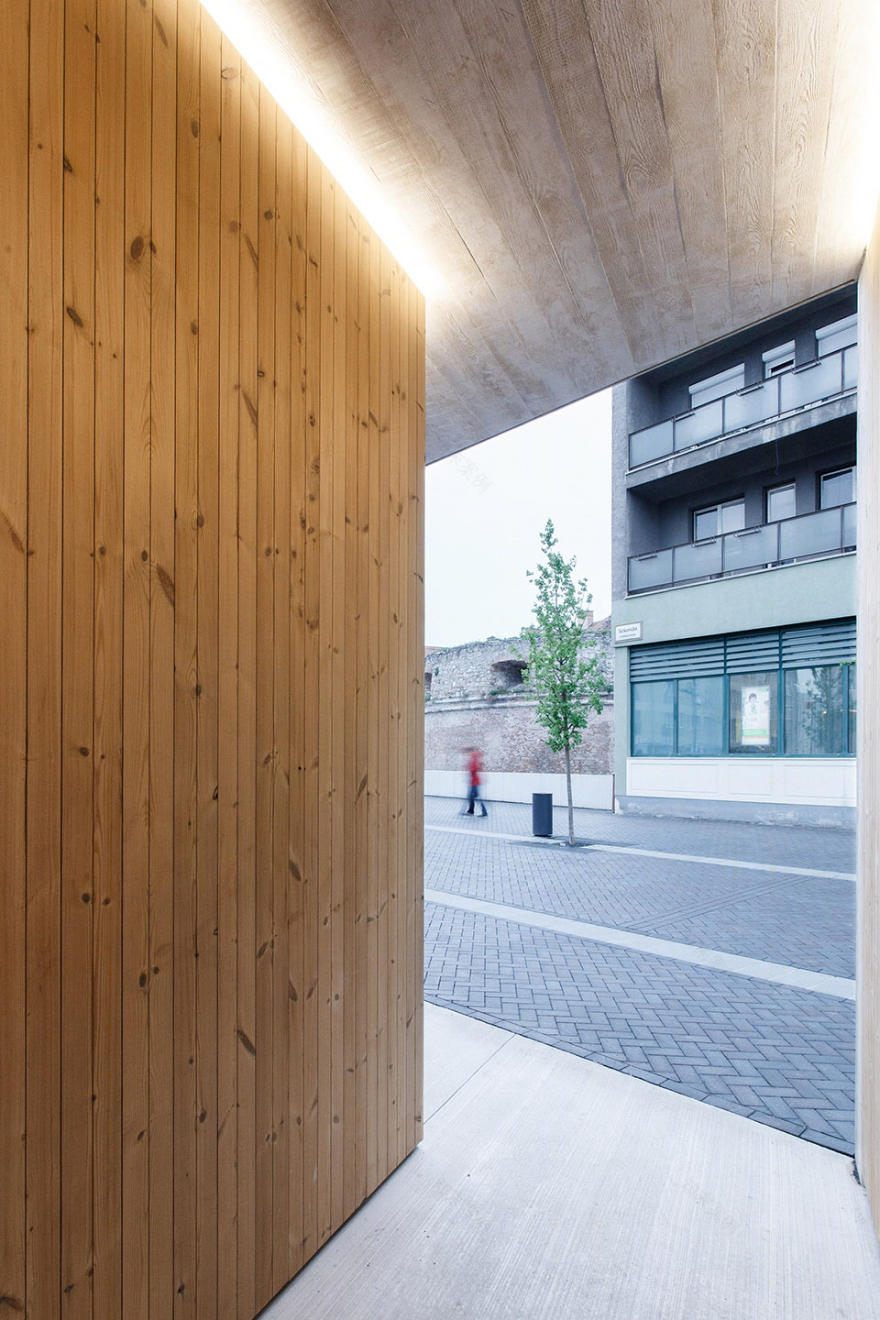


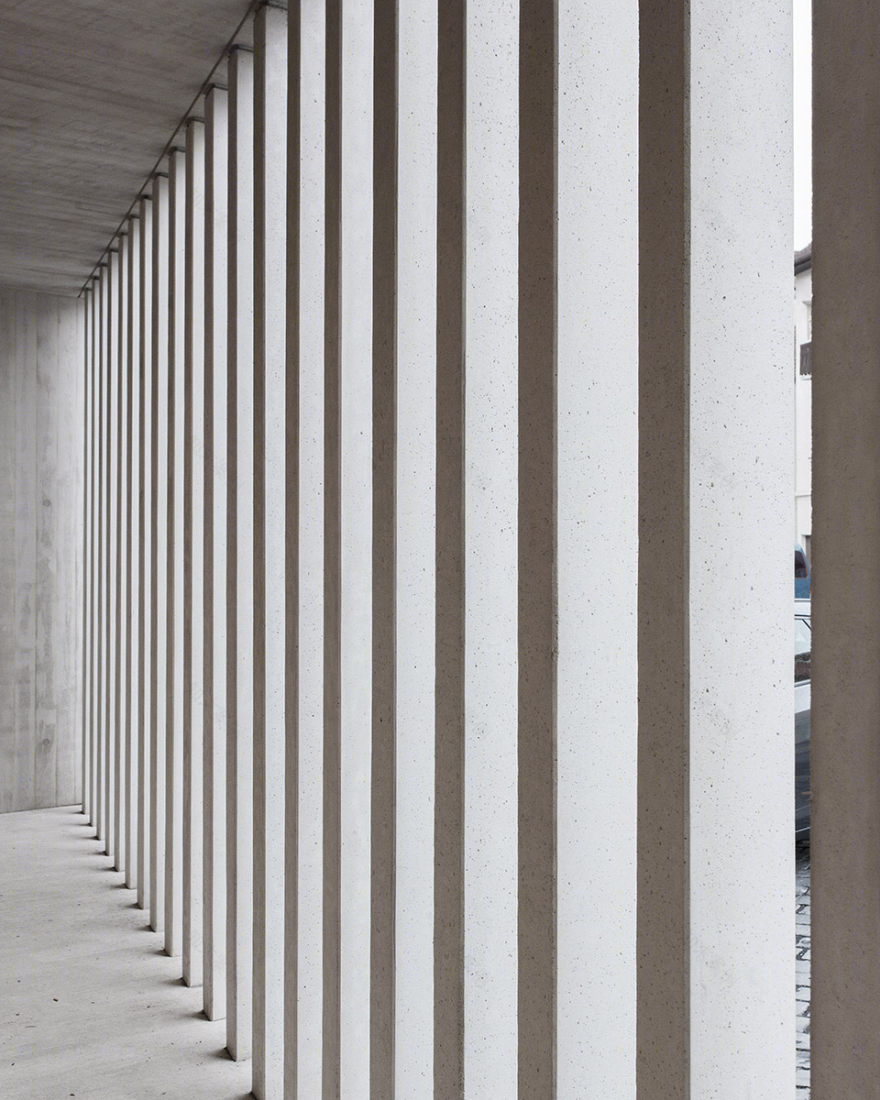
城堡区复兴计划的第一阶段,也是任务量最大的一个阶段已经完成。接下来开展的将是市中心周围区域。而市中心广场更新计划已经开始,预计和Kisvárkerület (小城堡区) 以及Széchenyi tér两个毗邻区的更新改造一起结束。
The first and largest phase of the Castle District has been completed, and now it indicates the direction for further developments of the areas surrounding the city core. The already started public plaza revitalization of the city center will be finished with the renewal of two large connected areas, Kisvárkerület (Small Castle District) and Széchenyi tér.

Barnabás Winkler在他的评价中是这么形容这片更新的公共空间的:“来此游玩的游客对恢复活力的城区喜闻乐见,当地居民的这种感情尤甚。城堡区不再只扮演流通区的角色,在这儿有真正的城市生活。一度消失不见的亲切氛围再次回到这里,这个用现代材料重建但保留小城的舒适的城堡区。”
With regard to the renewed public space, Barnabás Winkler wrote in his review: “Visitors to the city, but especially the residents of Sopron are visibly happy about the revitalized urban district. The Castle District is no longer merely a circulation zone, but it is filled with real urban life … The once intimate atmosphere of the Castle District has returned, being reformulated with modern materials, but preserving the small-town coziness.” (Régi-új Magyar Építőművészet 2016/3)
▽ 总图,Site Plan
▽ 总图,Site Plan
▽ 游客中心平面图,visitor center Floor Plan
▽ 游客中心立面图,visitor center Elevation
Address: Sopron, Castle District
Area: appr. 15 000 m2 public space and 40m2 public building
Design phase: 2009 (national competition), 2010-2013
Construction: 2014-2015
Client: Sopron City Council
Architecture:
Architect in charge: Levente Szabó DLA
Landscape design: Csenge Csontos (†), Borbála Gyüre, Gergely Lád (Geum Műterem Ltd.)
Co-architects: Balázs Biri, Jessica Dvorzsák, Dávid Kohout, Orsolya Simon (Competition: Orsolya Almer, András Páll, Tibor Tánczos)
Inspector of monuments: András Veöreös, Sándor Tárkányi
Traffic engineering: Ádám Rhorer, András Mezey (Közlekedés Ltd.)
Public utilities: Ádám Szabó (Aqua-Duo-Sol Ltd.)
Street lighting technology: Tibor Galazka, Ferenc Horváth (GT-Vill Ltd.)
Civil engineer: Csaba Horváth
Structural expert: Géza Kapovits
Water engineering: Gergely Drobni, László Skublics
Accessibility: Anna Kormányos
General contractor: VEMÉVSZER Ltd.
Awards: ICOMOS Award 2016,
DaNS 20th Salon of Architecture in Novi Sad, Salon Award in urban design category
Photos: Balázs Danyi
MORE:
Hetedik Műterem Ltd.
更多请至:
南京喵熊网络科技有限公司 苏ICP备18050492号-4知末 © 2018—2020 . All photos and trademark graphics are copyrighted by their owners.增值电信业务经营许可证(ICP)苏B2-20201444 苏公网安备 32011302321234号
苏公网安备 32011302321234号客服
消息
收藏
下载
最近