

创作上传
VIP
收藏下载
登录 | 注册有礼
查看完整案例



收藏

下载

分享


“The different kinds of access you get to the environment are appreciated. . . The project includes beautiful materials that fit within the landscape. It’s inviting. It gets you close to nature.”
– 2014 Awards Jury
“通往此地的不同路径令人赞赏…该项目中包含有适合此景观的美丽元素。设计引人心动,令你能够亲近自然。”
——2014年大奖委员会
来自
ASLA
Laurance S. Rockefeller Preserve by
Hershberger Design
项目陈述 PROJECT STATEMENT
劳伦斯·S·洛克菲勒提出了一个颇有远见的项目,旨在通过沉浸于自然景观之中,以一种强调环境保护的方式平衡土地保护以及公众访问。精心设计的入口,路径网络以及适当的解说中心使得访客得以通过轻微的接触,选取的路径,以及变革的特性,参与漫步于国家公园布景之中的体验独特的经历。该项目被送给美国公众,成为了所有国家公园中第一个获得LEED铂金奖的项目。
Laurance S. Rockefeller introduced a visionary plan to balance land protection and public access in a way that emphasized environmental stewardship through immersion in the natural landscape. A choreographed entry, trail network and modest interpretive center engage visitors in an experience unique among national park settings through its light touch, extractive approach, and transformative qualities. The project was gifted to the American public becoming the first within all National Parks to achieve LEED Platinum standard.
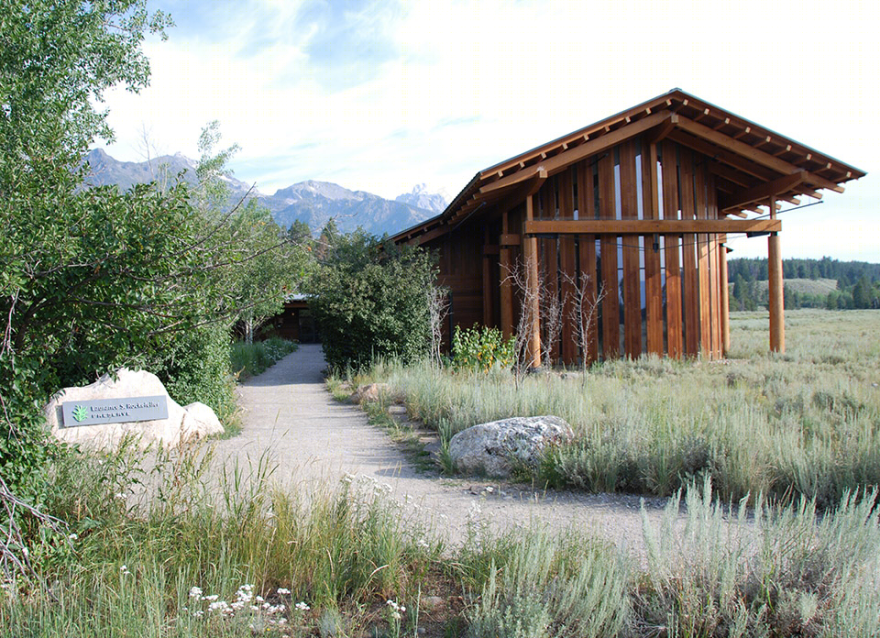
▼建筑物的入口通道开始于景观之中,将访客引导至前门。
The building entry passage begins in the landscape, leading the visitor to the front door.
Photo Credit: Hershberger Design
项目背景:具有深厚历史的景观
劳伦斯·S·洛克菲勒(LSR)终其一生已经保护区与许多知名的保护区联合共同努力,通过发起,组织以及按此方法管理项目,以确保公众会最终受益。他将自然视为个体全面发展中不可缺少的组成成分。因此,当他决定在2001年时将1106英亩的土地掌控授予大提顿国家公园(GTNP)时,洛克菲勒坚持他将会亲自施行此项目,作为对其信念的表达,亦即个人在自然方面的经验可以具有变革的能力,并且提高他们对环境保护以及个人环保职责的理解及赞赏。完成的项目在2007年被转换为国家公园服务处,同时获得一笔用于其维修及保养的资金。
LSR对于平衡了公众乐趣及对敏感资源的说明解释,同时作为环境保护的楷模的景点具有详细的设想。最终的概念通过将现存的发展自景点处移除,包括35处历史小屋以及不必要的道路及基础设施,成功地消除了数代人类影响的效果。在它们原先的位置,如今是经过仔细规划的路径,通过重造原生态环境,以及将说明中心连接至北部的菲尔普斯湖 ,提供了卓越的环境体验。
设计价值:尊崇及共享土地的遗产
每年,GTNP都吸引了将近三百万的游客,并且如同大部分常常被访问的景点一样,此处所受的喜爱,以及访问,是十分危险的——甚至可以致死。在规划过程的开头,LSR要求设计者们通过改变访客游历景点的方法,挑战传统的国家公园体验。景观设计师通过解决景点的不完备以及情绪化的特性进行回应,出去人类活动印记的覆盖,并使其返回到其原始状态。停车及到达区域,与说明中心相分离,位于此前受到现有畜栏干扰的位置。说明中心坐落于前农场房屋位置处的灌木草地的边缘处。所有构建的结构从物理上即被地形和植被分离,并且通过说明性的步道系统相连接。
LSR保护区的设计通过摒弃掉所有多余及不必要的元素,捕捉到了公园的自然环境的根本要点。最终结果是进行相较于此前对环境影响更少的计划。通往中心的四分之一英里的旅程要求访客首先与他们的交通工具相分离,并且立即沉浸到更为大型的景观之中。大提顿峰,可在背景之中观赏到,但却不是本次体验的焦点所在。与大部分国家公园相比,说明中心并非目的地而仅仅是通过视觉,听觉以及感官的展品说明亲身处于大自然之内的体验。访客们离开中心时平静而又若有所思,并且更加准备好融入周边景致。沿着连接中心与湖的步道布置的说明元素是可触碰的,它们鼓励访客通过触摸流水,感受叶子纹理,攀爬岩石,聆听风语,听取回音,观赏野生动物,体味原生植被的气息,鉴赏湖中的倒影,从而真正融入到景观之中。与大部分国家公园中的步道不同,此处的步道的设计并非在于将使用者迅速从某处移动到另一处,它经过精心设计,以便影响所有经过之人的感觉和情绪。有目的地的狭窄的单向路径系统限制了使用者堵塞的情况,更加促进其沉浸于周边环境之中。在湖边,设立了远处的景点以便眺望湖水风光,其位置位于相当适当的距离,由此人类的存在相对于自然景观成为了次要的存在。
景观设计师的作用
景观设计师对此地及其季节特性进行了超过两年的研究,并且与客户及设计小组直接合作,以便开展故事,指引保护区的总体规划及现场设计。现场设计元素例如湿地步道以及瀑布平台的设计给访客以出人意料的视角以及独特的体验,由此提高认识。景观设计师帮助进行了新建筑结构的选址,并且促进进行了公园内,以及客户的新家庭居所处所有现存建筑物的迁移及重新使用。景观设计师对于此地的丰富知识最终带来了专注于对于土地及此位置的要素进行表达及交流的体验的步道布局及体验。
环境敏感度及可持续性:锻造未来
对于该项目的愿景——最小化对于土地的影响:最大化对于访客的影响——是促进所有设计变化的重要因素。在公众融入环境是首要考虑的问题的环境中,此概念允许所有年龄及不同能力的访客放慢脚步,并且利用他们的感官及直觉完全沉浸在自然风光之中。自从在2007年6月正式开放起,LSR保护区就在公众之间激起了压倒性的积极响应,这一点远远超出了公园的期望。访客日志的条目证明了此项目对社区的影响,并且记录了对整个体验的衷心反应。“实在是太美了——真是一次感官的盛宴。我即将离开,并且将会带着更为诚挚的敬意踏上我的旅途。谢谢你们!”
重要因素
在一次高度合作的努力之中,景观设计师,建筑师,工程师,以及说明及资源专家的小组与客户一起共同合作超过五年,最终真正了解此地,探索了设计理念并且实施了一个将景观路径及环境保护的体验相结合的方案。结果是一项以体验为基础的设计,这是一项国家公园系统内的环境保护模型。
这个项目所依赖的选择步骤十分独特,因为,它没有向此景点增添新的元素,而是要求以现存的条件来讲述故事。未增加停车场及拓宽步道,相反它对二者进行了减少,这意味着游客们需要仔细思考其完全融入自然景观的总体目标。
LSR鼓励景观设计师在适应此项目时遵守纪律,并且进行了深思熟虑。直到完成项目后,允许小组进一步改善方案,使其专注于环境保护以及访客体验,而非普通的停车率及访客标准时,该项目才被传达给国家公园服务处。
区分这些项目的现场设计元素包括有
超过30处建筑物进行了移除以及迁移以便重新使用。三英里的道路沥青得到了回收,在入口道路对其进行了再利用。删去了日常水电,并且将一处行车天桥转换为了人行天桥。最终结果是省下了155.2吨的拆建废物。
从本土植被处收获到了种子,并且将其种植于垦区。收集巨石用于在景点俯瞰以及建筑物。通过现存的一口井提取饮用水,并且通过自然过滤进行了重新注入。该项目减少了96%的用水,又或是每年减少使用76,000加仑的水。这是怀俄明州以及国家公园服务处的第一个获得LEED铂金奖的项目。
▼LSR说明中心坐落于森林边缘,距离停车场有四分之一英里远。移除的道路被重新开垦为鼠尾草草甸。
The LSR Interpretive Center is located at the forest edge, a quarter-mile from the parking lot. Removed roads were reclaimed to sage meadow.
Photo Credit: Hershberger Design

▼总平面图
Site Plan.
Photo Credit: Hershberger Design

▼在仅仅能够容纳50辆车的停车场中央,设有一个生物洼地收集径流。一条位于中央位置的木板人行道使得访客得以进入湿地中的路径,并且将他们引导至一条穿过芳香四溢的鼠尾草草甸的路径处。
In the middle of the modest 50-car parking lot, a bioswale captures runoff. A centrally-located boardwalk engages visitors with the wetland channel and leads them to a trail through an aromatic sage meadow.
Photo Credit: D.A. Horchner

▼(左)一处蝶式屋顶亭在步道口与游客们亲切地打招呼。非典型的NPS凉亭,提供的水源位于远离读者的位置,使得公众得以完全注意到环境保护的信息。
(left) A butterfly roof kiosk greets visitors at the trailhead. Atypical of NPS kiosks, water is effectively channeled away from the reader allowing complete attention to the message of stewardship.
Photo Credit: D.A. Horchner
(右)穿孔的金属走道鼓励访客体验清凉的山间溪流,并且与瀑布亲近,这在普通的国家公园环境之中是难以经历的体验。
(right) A perforated metal walkway encourages visitors to engage with the cold mountain stream and become intimate with a waterfall, an experience that is difficult to achieve in typical national park settings.
Photo Credit: D.A. Horchner

▼一个简单的水平即填充了采用回收金属建造的小站,而一块当地的巨石则使得访客们回想起水资源在形成此地景观的重要作用。
A simple water bottle filling station constructed of recycled metal and a native boulder reminds visitors of water’s important role in shaping this landscape.
Photo Credit: David Swift

▼弯曲的木板人行道平台使得访客得以体验溪流的环境。在春天,溪流在高径流期间奔流于木板人行道之下。静思默想的绝妙地点,大型的平台邀请访客们驻足观赏并且聆听。
The curved boardwalk deck allows visitors to experience the creek environment. In the spring the creek runs under the boardwalk during high runoff. A great spot for quiet contemplation, a large bench invites hikers to stop, look, and listen.
Photo Credit: D.A. Horchner

▼溪上小桥可作为俯瞰眺望之地,鼓励访客观察景致之中水的力量以及其在不同季节时的形态。
The Lake Creek Bridge acts as an overlook, encouraging visitors to observe the power and seasonal states of water in the landscape.
Photo Credit: Hershberger Design, Nic Lehoux

▼(左)改造前的湖畔:景点中有35处结构被移除,并且在大提顿国家公园以及附近的农场进行了重新使用。移除并重整了大量的道路系统以及停车场。
(left) Lakefront Before: Thirty-five structures on the property were taken away and reused in Grand Teton National Park and nearby ranch sites. An extensive road system and parking lot were removed and reclaimed.
Photo Credit: Hershberger Design
(右)改造后的湖畔:采用简单的步道系统以及宁静的湖畔眺望台替换了小屋等等。湿地系统进行了重新连接和重建。
(right) Lakefront After: Cabins and development were replaced by a simple system of trails and quiet lakeside overlooks. Wetland systems were reconnected and reestablished.
Photo Credit: Hershberger Design, D.A. Horchner

▼原有的车行天桥的材料被重新利用以连接小溪两岸的步道。旁边的长椅邀请远足者在此休息并且享受周边的美景。开放水域的周围设置的围栏使得访客们能够倚靠于此并且欣赏溪流。
The original vehicular bridge was repurposed to connect trails on both sides of the creek. Benches invite hikers to relax and enjoy the environment. Railings placed adjacent to open water allow visitors to lean over and view the stream.
Photo Credit: Hershberger Design, Nic Lehoux

▼穿越湿地区域的金属步道。长椅由植被分隔,可供人休憩及思考。随着季节的改变,湿地发生了奇妙的变化,从清泉径流变成了色彩及纹理交织的草甸地毯。
A metal boardwalk crosses a wetland area. Benches, separated by vegetation allow for resting and contemplation. Throughout the seasons, the wetlands change dramatically from clear spring runoff to a lush carpet of color and texture.
Photo Credit: Hershberger Design

▼许多历史悠久的小屋被仔细重新放置于邻近LSR保护区的新位置。景观设计师监管了小屋移动的工程,检视了总体规划以及新的牧场组成的建设。
Many of the historic cabins were carefully relocated to a new site close to the LSR Preserve. The landscape architect supervised the cabin move, master plan and construction of the new ranch compound.
Photo Credit: Hershberger Design

▼建立农场池塘以便收集公路建设集料,建筑物及公用设施回填,由此得以减少非现场建造带来的影响。
The ranch pond was created to harvest aggregate for road construction and structural back-fill for buildings and utilities resulting in reduced off-site construction impacts.
Photo Credit: D.A. Horchner

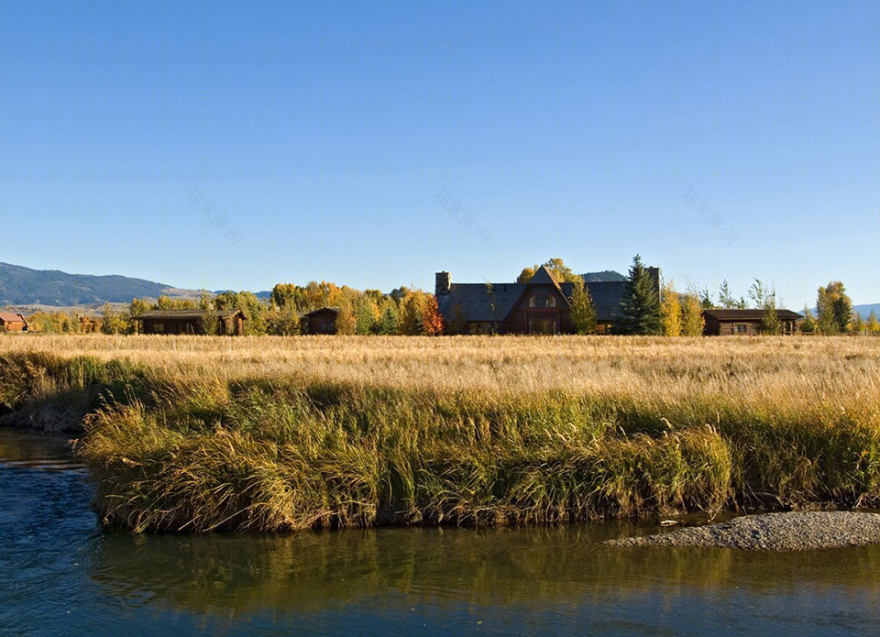
▼历史性小屋与本地植放置在一起以便保护它们免受严酷的山区天气的影响。所有的小屋都有独特的外围视野,可以观赏到农场及群山。主要别墅区直接面向其原先的所在之处,即LSR保护区。
The historic cabins were clustered with native plantings to shelter them from harsh mountain weather. Each cabin has a unique perimeter view of the ranch and mountains. The Main Lodge is oriented directly to its former home, the LSR Preserve.
Photo Credit: D.A. Horchner
Project Background: A Landscape with History
Laurance S. Rockefeller (LSR) has been associated with many well-known conservation efforts over his lifetime by initiating, organizing, and administering projects in such a way to ensure the public would ultimately benefit. He viewed nature as the essential ingredient in the full development of the individual. As a result, when he decided to grant the 1106-acre inholding in Grand Teton National Park (GTNP) in 2001, Rockefeller insisted that he would implement the project himself as an expression of his belief that the quality of an individual’s experience in nature can be transformative and heighten their appreciation and understanding of stewardship and personal environmental responsibility. The finished project was turned over to the National Park Service in 2007 complete with an endowment for its upkeep and maintenance.
LSR had a specific vision for the property that balanced public enjoyment and interpretation of sensitive resources while serving as a model of environmental stewardship. The final concept has succeeded in reversing the effects of generations of human impact through the removal of existing development from the property, including 35 historic cabins and unnecessary roads and infrastructure. In their place is a network of carefully orchestrated trails providing remarkable environmental experiences through reclaimed native habitats and linking the interpretive center to Phelps Lake at the north.
Design Value: Honoring and Sharing the Legacy of the Land
GTNP attracts approximately 3 million annual visitors and like most highly visited landscapes, this one was in jeopardy of being loved – and visited – to death. At the outset of the planning process, LSR requested that the designers challenge the typical national park experience by changing the way in which a visitor experiences the landscape. The landscape architect responded by addressing the raw and emotive qualities of the landscape, stripping it of human overlay and returning it to its native condition. Parking and arrival areas, separated from the interpretive center, are on the site of previous disturbance from an existing corral. The interpretive center sits at the edge of a sagebrush meadow on the site of former ranch housing. All built structures are physically separated by topography and vegetation and connected by an interpretive trail system.
The design for the LSR Preserve captures the very essence of the park’s natural setting by stripping away all extraneous and unnecessary elements. The end result is a plan with less impact to the environment than that which existed before. The quarter-mile journey to the center requires that visitors first separate from their transportation and immediately commit to immersing themselves in the larger landscape. The Grand Teton, while visible in the background, is not the focus of the experience. In contrast to most national parks, the interpretive center is not the destination but simply a stop that illuminates the experience of being in nature through visual, auditory and sensory exhibits. Visitors leave the center calm and reflective, and ready to fully engage with the surroundings. Interpretive elements along the trail connecting the center and the lake are tactile, encouraging visitors to engage with the landscape by touching water, feeling leaf textures, climbing on rocks, listening to the wind, hearing an echo, watching wildlife, smelling native vegetation, and seeing reflection in the lake. Unlike most trails in national parks, this one is not organized to convey users quickly from one point to another, but rather it is choreographed to impact the senses and emotions of all who pass. A purposefully narrow and one-way routing system limits user congestion, facilitating immediate absorption with the surrounding environment. At the lake, overlook opportunities are set back from the water and located at appropriate distances so that human presence is secondary to the natural landscape.
Role of the Landscape Architect
The landscape architect studied the site and its seasonal qualities for over two years and worked directly with the client and design team to develop the story that would guide the master plan and site design for the Preserve. Site design elements such as the wetland walkway and waterfall deck were designed to give visitors unexpected perspectives and unique relationships to heighten awareness. The landscape architect was instrumental in siting the new structures, and facilitating the relocation and reuse of all existing buildings throughout the park and at the client’s new family compound. The landscape architect’s intimate knowledge of the site resulted in a trail layout and experience focused on expressing and communicating the essence of the land and the location.
Environmental Sensitivity and Sustainability: Forging into the Future
The vision for the project – minimum impact on the land: maximum impact to the visitor – was the catalyst for all design choices. In a setting where public engagement with the environment is paramount, the concept allows visitors of all ages and abilities to slow down and utilize their senses and intuition to completely immerse themselves into nature. Since its official opening in June 2007, the LSR Preserve has inspired an overwhelmingly positive public response that is far beyond the Park’s expectations. An entry in the visitor log attests to the project’s impact on the community, and documents the heartfelt reactions to the entire experience. “Absolutely beautiful – a treat to the senses. I leave and will walk my path with broadened respect. Thank you!”
Significant Factors
In a highly collaborative effort, the team of landscape architects, architects, engineers, and interpretive and resource specialists worked with the client for over five years to understand the site, explore design ideas and implement a plan that marries site access and experience with environmental stewardship. The result is an experience-based design that is a model of environmental stewardship within the National Park system.
The extractive process on which this project relies is unique because, rather than adding elements to the site, it requires that existing conditions tell the story. Instead of increasing parking and widening trails, it reduces both, signifying a need for visitors to thoughtfully ponder the overall objective of engaging fully in the natural landscape.
LSR encouraged the landscape architect to be disciplined yet contemplative in their approach to the project. The project was not conveyed to the National Park Service until after completion allowing the team to develop the plan focusing on environmental stewardship and visitor experience, not typical parking ratios and visitor standards.
Site design elements that distinguish this project include
Over 30 structures were removed and relocated for reuse. Three miles of road asphalt were recycled for use on the entry road. Overhead utilities were removed, and a vehicular bridge was transformed into a pedestrian bridge. The result was a savings of 155.2 tons of demolition waste.
Seed was harvested from native plants and planted in reclamation areas. Boulders were collected for reuse on site overlooks and on the building. Potable water is extracted through an existing well and recharged through natural filtration. The project achieved a 96% reduction in water use, or an annual savings of 76,000 gallons. This is the first project in Wyoming and in the National Park Service to achieve a LEED Platinum Standard.
MORE:
Hershberger Design
,
更多请至:
南京喵熊网络科技有限公司 苏ICP备18050492号-4知末 © 2018—2020 . All photos and trademark graphics are copyrighted by their owners.增值电信业务经营许可证(ICP)苏B2-20201444 苏公网安备 32011302321234号
苏公网安备 32011302321234号客服
消息
收藏
下载
最近