

创作上传
VIP
收藏下载
登录 | 注册有礼
查看完整案例



收藏

下载

分享

翻译
你可能还喜欢
换一换
Architect:Kadarik Tüür Arhitektid
Location:Tallinn, Estonia; | ;
Category:Offices;Shops;Housing
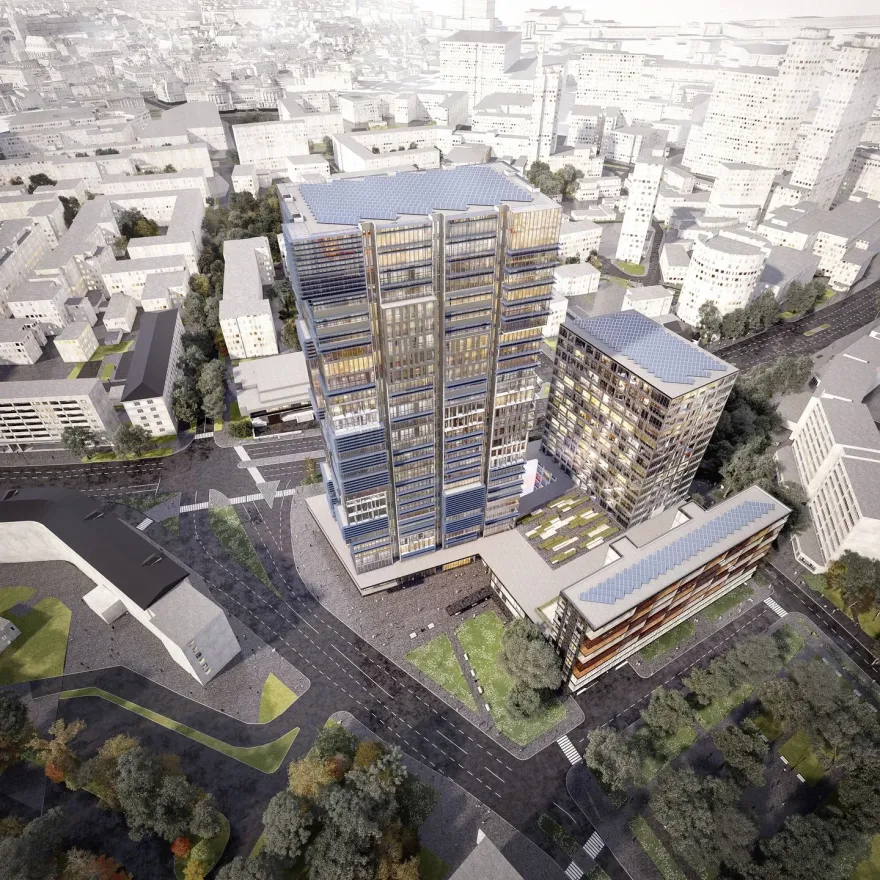
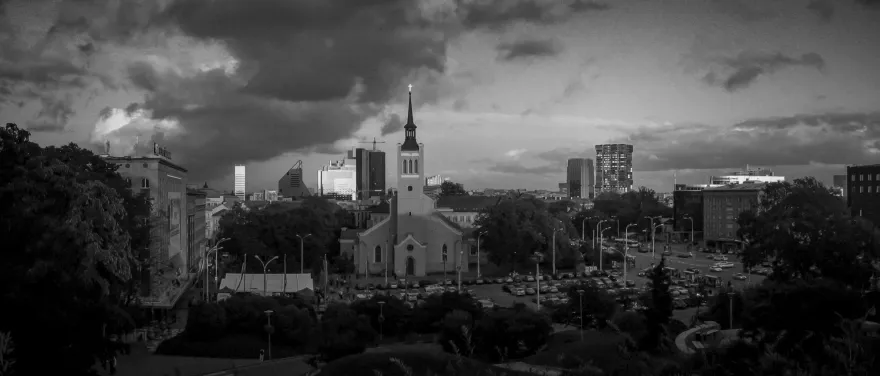
The client is looking to build a contemporary and advanced multifunctional business quarter in a rapidly developing and highly prestigious city - the capital of Estonia, Tallinn. The city block is highly visible in terms of urban location, at the intersection of Liivalaia and Juhkentali streets. The area is architecturally heterogeneous and has a rich history. Opposite the competition area, there is Radisson Blu Hotel Olümpia, rising to the height of 84 meters, and just next to the site - a small wooden orthodox church (Church of Our Lady of Kazan). Historically the area comprised small-scale wooden housing blocks. A river used to flow through the area with a sufficient drop in water levels to justify building nearby a mill and a reservoir. The river was also used for bleaching textiles, especially linen.
The subsequent history has only added to the diversity of coexisting scales and styles. This raises a question of how to do justice to this variety, making links to as many scales as possible and unifying the area into a well-functioning city space in a way that fully supports the developer’s ambitious vision for a new outstanding business quarter. This is why we believe it is necessary to regard the planned office towers as series of smaller multiform volumes stacked upon each other, resulting in a sort of vertical village with different working conditions in different areas of the building. This has the additional bonus of resonating with the heterogeneous surroundings of the site.
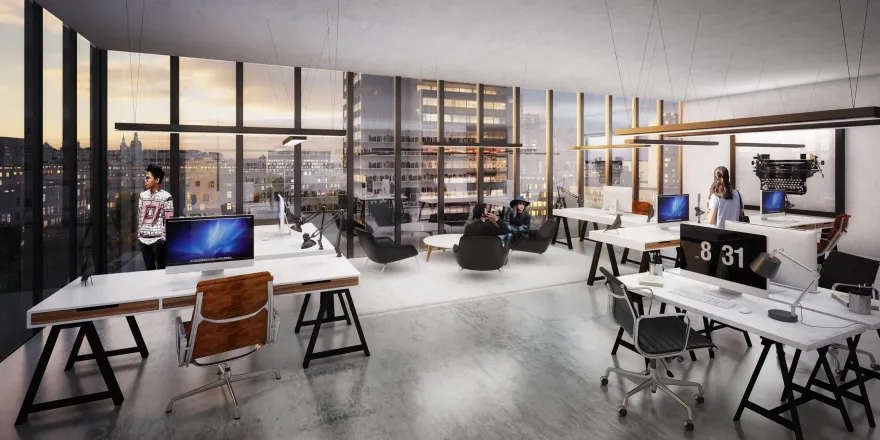
One of the main headaches for a developer of an office building has been satisfying the needs and expectations of different tenants. Some of them look for luxurious spaces with exquisite views, willing to spend more on extra maintenance costs, whereas others - perhaps more environment-conscious - for energy-efficient solutions, willing to sacrifice the floor-to-ceiling windows for this ideal. So, if the building has a homogeneous design, it is necessary to compromise between different needs and expectations, where none of the tenants would be fully satisfied and would be forced to adapt to the minimum variety of conditions on offer. With the solution we are proposing, no such concessions are necessary, as great variety of different working conditions covers a whole range of possible needs of the buildings’ potential tenants.
The main tower, 111 meters high, is designed to be the eminent building of the quarter, with more emphatic features, whereas its lower brother shall be acting as a more modest sidekick. The first three floors of the office towers form a common volume, with an atrium, shops and cafés on the first floor, fitness centre on the second, and food court on the third floor. On the fourth floor, the volumes diverge, however, similar structure remains: the service core in the middle, surrounded by an area of foyers and kitchen spaces, with the multifarious working areas in a well-lighted perimeter. As an extra feature, the main tower has local halls with greenery, located in the spaces protruding from the main building volume.
The residential block faces away from the towers, orienting its main face of living rooms and glazed deep balconies to the southeast, catching the sun and the greenery to the south. The main facade of the residential building resonates with the heterogeneous look of the main office tower by giving each apartment a different look: the dominant material used is natural stone. Balcony setbacks are clad in wood. The variation is achieved through the use of different spaces, rhythms and finishes. There is a private daycare centre for children on the first floor of the housing block facing the park. In future, busy streets will surround the whole city block, so it is important that the quarter has no neglected “backsides”. This has been accomplished by means of giving equal attention to the streets on every side of the quarter. In place of the current gas station we propose a new park and a plaza to accompany the second main entrance. The proposal also foresees amendments to the existing greenery lying to the south of the residential volume, turning it into an attractive park area.
Since it is a large quarter with nearly 5,000 people occupying it, disregarding the visitors, it is crucial to ensure a smooth internal logistics. The quarter may be accessed by car via the entrance gate, positioned in one area on the periphery of the building. Within named area also includes the loading of goods and the transportation of waste. For the visitors coming on foot there is a maximum number of entrances accessible from the street. The employees may reach the elevator lobby of the two office towers directly, without having to go across the atrium. The atrium is the quarters’ logistical hub for the visitors. It has all the information about what is happening in the quarter. An easy access to the atrium is provided from all four directions. On the periphery of the atrium there are shops and cafés. On the second floor of the quarter, there is a separate entrance to the fitness area, which can be opened independently from the rest of the building. It is possible to regulate the access to the elevator lobby of the office buildings by means of gates that function via card system. Cohesive infographic is crucial for a quick search of companies within the quarter. The infographic is uniform in the whole quarter and is presented as a system, which binds together all three buildings. Waste storage gate opens directly onto the street. By the means of this gate, it is possible to change central waste press of the garbage truck.
All technical systems are designed in such a way that they can operate independently per block. Each building operates on separate technical equipment, so that its management and maintenance are autonomous. Logistics of the parking lot, as well as movement of goods and garbage in the quarter, are resolved centrally.
In order to achieve an energy-efficient building, solar control glass and sun protection panels are used on the windows. Solar control glass g = 0,3 is used on the eastern, western and southern facades. Enclosed facade surfaces are covered with lightweight composite panels, which may be installed either as part of the aluminium facade system or as prefabricated panels.
Technically, the most complex part of the quarter is a 30-storey tower. The ventilation system of this building is resolved centrally on the basis of a ventilation chamber located on the 15th floor, from which two shafts (7.5 m2 each) run down and up. The shafts must be airtight to prevent chimney effect. The roofs of the towers are covered with solar panels. The horizontal facade is also partly covered with solar panels that also act as shields for windows.
The office building is equipped with a central elevator core, which also acts as a stiffening element for the building. The office space reaches the area next to the outer perimeter. Adjacent to the evacuation stairwells, there is a corridor of technical premises, which also acts as a smoke proof enclosure.
Residential block ventilation is solved via separate autonomous equipment installed in each apartment. Stationary window cleaning system with baskets is provided on top of the roof for all quarter buildings.
Ground level is between +12 and +14 meters. The groundwater level is at 2-3 meters below the ground surface. Thus, at least the lower parking lot shall be maintained with groundwater at full height. Due to the number of storeys of the building and the water uplifting pressure, the foundations are designed differently in order to ensure a uniform finish: 30-storey building is expected to have piles of approximately 35 meters lengthwise. Structural scheme is primarily a carcass solution, where a stiffening core, consisting of the walls of the elevators, communication shafts, and stairs, ensures the stiffness and stability of the buildings. Only the lower residential building shall be designed with internal and external bearing walls on the ground, which provide the building with sufficient stiffness. The structural scheme of the underground part of the buildings is cast reinforced concrete. Walls and basements are watertight and are subject to soil and water pressure. On the ground surface, the load-bearing structures differ per building. In the case of a 30-storey tower (tower 1), load bearing posts of the outer perimeter are shifted into the building by approximately two meters in order to make it possible to cut into intermediate ceilings on the each side of the building. Therefore, the intermediate ceilings opening is 8m, which is balanced by the 2meter cantilever. Structural scheme of tower 2 is similar, except that the load bearing posts of the outer perimeter are placed around the perimeter. Due to regular step of the load bearing posts, it is possible to construct them from elements (if the beams do not interfere with communications and/ or the height permits). The third building is designed as an elemental structure, where prestressed hollow core slabs rest on the load-bearing walls.
Energy-efficiency
Technical solutions to ensure near zero-energy building:
• High-efficiency ventilation equipment (rotor or counter-flow).
• The heat pumps are installed in the ventilation equipment, which can provide a significant amount of heating and cooling without additional energy.
• Ventilation is based on the variable air volume (VAV), i.e., the airflow of each office is controlled in the area. This will significantly reduce office energy consumption.
• Cooling is carried out via separate equipment: there is a separate chiller for cooling the ventilation systems and a chiller for fan-coils. The chiller for fan-coil is equipped with a free cooling solution. Ventilation devices with heat pumps may be considered as an alternative, which would mean that they do not need a separate chiller.
• Cooling systems are dry cooling systems and prevent the energy loss on condensation.
• Heating temperature is designed to be as low as possible to prevent the heat carrier agent heat loss. Technology systems are balanced with dynamic solutions.
• Automation plays a very important role in energy efficiency, which has a significant impact on the future development of the project.
▼项目更多图片






 14
142016/11/15 20:25:43
712016/06/29 14:57:33
南京喵熊网络科技有限公司 苏ICP备18050492号-4知末 © 2018—2020 . All photos and trademark graphics are copyrighted by their owners.增值电信业务经营许可证(ICP)苏B2-20201444 苏公网安备 32011302321234号
苏公网安备 32011302321234号客服
消息
收藏
下载
最近