

创作上传
VIP
收藏下载
登录 | 注册有礼
查看完整案例

收藏

下载

分享

Farris工作室近期在比利时安特卫普省拥有9000名居民的小镇代瑟尔(Dessel)打造了22套社会住宅。这个比利时城市郊区住宅群围绕共享、集体生活和加强住宅单元特征展开,并以此提供一个典型社会住宅的标准化备选方案。
自20世纪80年代中期以来,比利时已经历长期房价上涨的阶段。鉴于严峻的经济形势,因安特卫普、根特和泽布吕赫三个主要港口以及布鲁塞尔国际机场而成为国家经济驱动力的法兰德斯地区也面临着日益严重的经济适用房短缺的问题。针对这一问题,拥有百年社会住房建设项目经验的比利时公司De Ark计划在代瑟尔建造一个由22套社会住宅组成的综合体。
Studio Farris Architects recently completed 22 social residences in Dessel, a small town of 9,000 inhabitants in the province of Antwerp in Belgium, The housing complex on the outskirts of the Belgian city is all about sharing, collective living and the enhancement of the identity of the residential units, so as to offer an alternative to the more standardized solutions typical of social housing.
Belgium has experienced a prolonged boom in house prices already since the mid- 1980s. As a result of the dire economic situation, the Flanders region – the country’s economic driver due mainly to the presence of the three major ports of Antwerp, Ghent and Zeebrugge and the Brussels- National International Airport – is also facing a growing shortage of affordable housing. In response to this problem, De Ark, a Belgian company with 100 years’ experience in implementing social housing projects, planned to build a complex of 22 social residences in Dessel.
▼项目概览,overview of the project

意大利建筑师Giuseppe Farris领导的安特卫普事务所Farris工作室在2012年6月De Ark发起的竞赛中脱颖而出。项目施工于2018年2月开始;建筑物于2021年3月建成,景观设计于2022年8月完工。22套住宅均已分配完毕。
22套住宅共包含6套119平方米的住宅,8套92平方米的公寓,以及8套78.5平方米的公寓。
▼概念草图,conceptual sketch
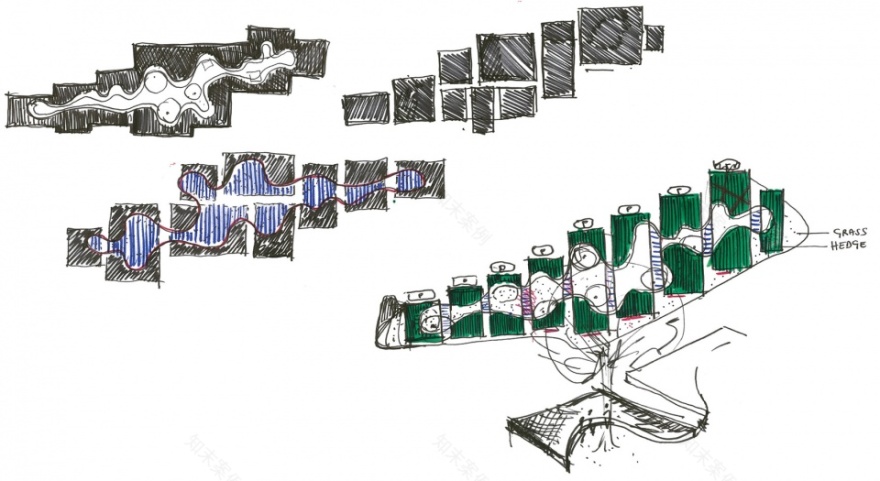
Studio Farris Architects, the Antwerp-based firm headed by Italian architect Giuseppe Farris, won the competition launched by De Ark in June 2012. Construction started in February 2018; the buildings were completed in March2021 while landscaping was finalized in August 2022. All 22 residences have been assigned.
They consist of 6 houses of 119 square meters, 8 apartments of 92 square meters, and 8 apartments of 78.5 square meters.
▼街道视角,view of the social housing from the street

Farris工作室提出了让住宅后退于街道的方案,将住宅和街道间作为向整个社区开放的大型公共花园。共享步行区可供人们消遣和放松。这个设计想法旨在围绕一个绿色的、公共的和共享的核心理念来发展街区的社会生活,同时确保每个住房单元都有一个小型的私人后花园,以此来营造家庭和亲密的氛围。这些住房单元均按照相同布局排布,客厅、餐厅、厨房和一间小型服务型卫生间在一楼;卧室在楼上。但是,每个房间的配置各不相同,定义外墙的形式也是不同的,因此,尽管同为综合体的一部分,每套住宅看起来都是一个独立的单元。
▼轴测图,axonometric drawing
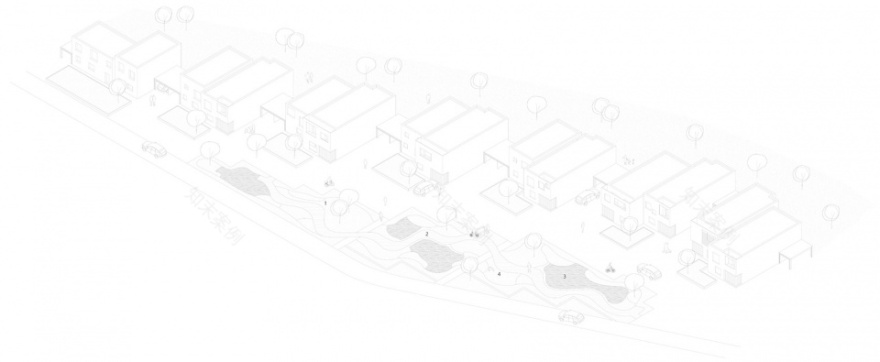
Studio Farris’ scheme has residences set back from the street so that a large public garden can be implemented to serve the entire neighborhood. A shared pedestrian area for spending time together and relaxing. The idea is precisely to develop the social life of the neighborhood around a green, public and shared core, and at the same time to ensure that each housing unit has a small private back garden, which favors a more domestic and intimate atmosphere. The housing units are all organized according to a common layout, with the living room, dining room and kitchen and a small service bathroom on the ground floor; the bedrooms on the upper floor. But the configurations of the various rooms are varied, as are the formal choices that define the facades, so that each dwelling appears as an independent unit, albeit part of a complex.
▼住宅和街道间作为向整个社区开放的大型公共花园,a large public garden between the residences and the street to serve the entire neighborhood

▼绿色、公共和共享的社区,the neighborhood around a green, public and shared core

▼共享步行区可供人们消遣和放松,a shared pedestrian area for spending time together and relaxing

▼从绿色区域看住宅区,view from the green area to the social housing

▼公共花园近景,close-up view of the public garden

▼社会住宅一瞥,a glance to the social housing

22套住宅分布于该地块7栋联排建筑中。在街道和住宅之间是一片可供集体使用的公园。每栋建筑都与街道正交,并由两个并排的平行四边形体量构成,其中一个平行四边形由另一个转换而来,其特点是宽度不变,长度不一。尽管是微小的差异,每栋建筑也存在高度差。该建筑群作为一个整体,呈现出一种松散的姿态,每栋建筑的退进也各不相同,形成了一种不断变化的相互影响。私人花园位于建筑物的后方。
▼住宅体块轴测示意图,diagram of the house blocks

The 22 dwellings are contained within 7 buildings that are arranged side by side in the inner part of the lot. Between the street and the residences is a green area designed as a park for collective use. Each building is placed orthogonally to the street and is defined by the juxtaposition of two parallelepiped volumes, one shifted from the other, characterized by a constant width and a varying length. Their height also differs, though slightly. As a whole, the complex takes on a loose configuration, in which buildings protrude and recede variably, resulting in an ever- changing interplay. Private gardens are located at the back of the buildings.
▼建筑的退进各不相同,buildings protrude and recede variably
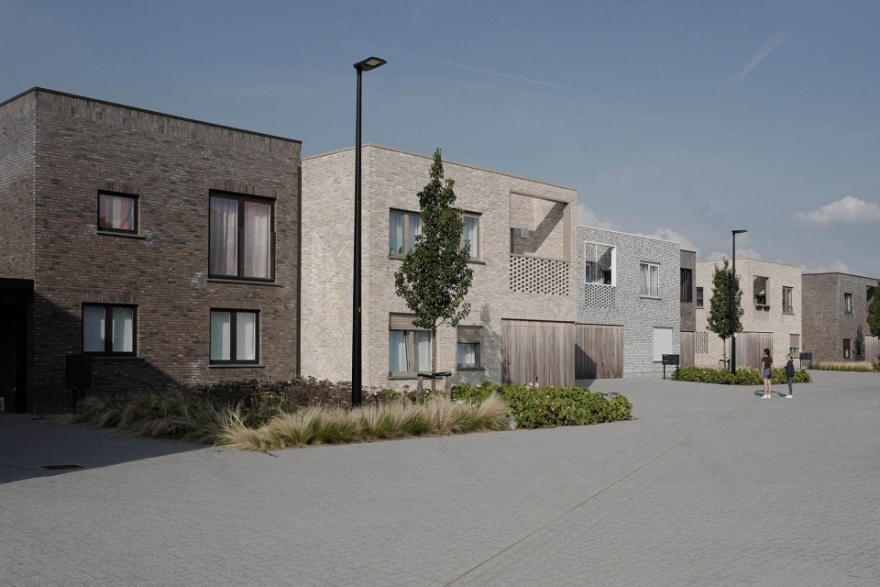
▼每栋建筑都与街道正交,each building is placed orthogonally to the street

▼建筑之间存在微小的差异,nuance between buildings

▼建筑间的空余空间,free space between buildings

Farris工作室以砖作为紧凑的平屋顶住宅的主要材料,这种典型手法在当地仍被广泛使用,同时工作室在立面设计中加入了不同的混合物和色彩,创造建筑与建筑间的轻微变化。外立面的大开口设计也与松散的体块构成相得益彰。
项目回收落在住宅屋顶和车棚上的雨水,并再次利用于住宅中的洗手间、花园灌溉和洗衣机。居民可以运用这个系统尽可能多地对水进行重复利用,其余的水则在土地范围内进行引导。即使没有污水处理系统,自然地下水位也能够得到补充。
The compact, flat-roofed houses are made of brick, a typical and still widely used solution in the local area that Studio Farris adopted while incorporating different mixtures and colors so as to create slight variations between one building and the next. On the facades, the ample openings also adhere to a loose composition.
Rainwater that falls on the roofs of houses and on carports is recuperated to be used in residences for toilets, garden irrigation, and washing machines. With this system, residents can reuse as much water as possible, and the rest is channeled within the land itself. A sewage system is no longer needed, and the natural groundwater level is replenished.
▼住宅建筑入口外观,exterior view of the entrance of the residence

▼住宅建筑侧面视角,side view of the residence

▼立面设计中加入了不同的混合物和色彩,different mixtures and colors are incorporated to create slight variations between one building and the next

▼砖墙细部,details of the brick walls

建筑平面的几何布局也影响了包括公园在内的绿色区域规划,公园的交错形态似乎反映了建筑区域的设计。与周围环境相比,公园的人行道和开放区域组成的灵动且蜿蜒的系统包含了从儿童游乐区到休息长椅的多种功能。然后是被称为河道的区域,这片湿地将广场上的雨水通过管道引导入排水系统,并让水慢慢渗入地下。
The geometric layout that rules the floor plan of the buildings also organizes the green areas, including the park, whose staggered shape seems to reflect the design of the built area. Within the park, in contrast to its perimeter, a fluid and sinuous system of pedestrian paths and open areas is defined to accommodate various functions – from a children’s play area to benches for resting. Then there are areas referred to as wadi, which are wetlands where rainwater from the square is piped into a drainage that lets the water slowly seep into the ground.
▼公园人行道和开放区域设有儿童游乐区和休息长椅,a children’s play area and benches for resting within the park

▼总平面图,master plan

▼一层平面图,level +0 plan

▼二层平面图,level +1 plan
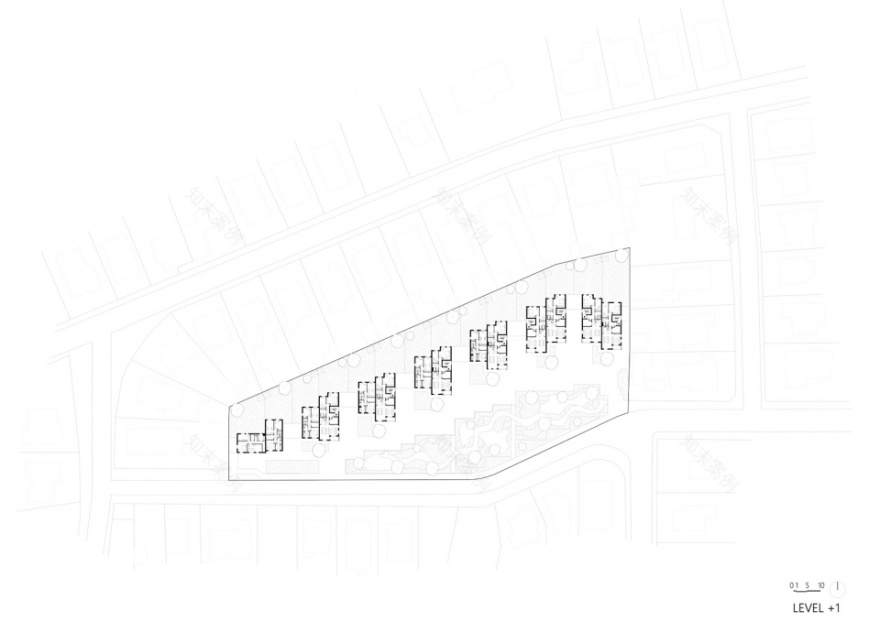
▼一层住宅平面,level +0 house plan

▼二层住宅平面,level +1 house plan

▼立面图,elevation

▼剖面图,section

Project name: Social Housing in Dessel
Project location: Dessel, Belgium
Architect: Studio Farris
Website:
Client: De Ark
Contractor: Artem
Schematic design start: 2013
Construction start: February 2018
Construction completion: March 2021
Landscape completion: August 2022
Plot area: 8.060 square meters
Covered area: 1.775 square meters
Landscape: 3.857 square meters
Number of units: 6 houses, 16 apartments
Average floor area of houses: 6 x 119 square meters
Average floor area of apartments: 8 x 92 square meters; 8 x 78,5 square meters
Number of floors above ground: 2
Materials: bricks, wood, aluminum, steel
Photographs: Koen Van Damme, Martino Pietropoli

 458
4582020/10/16 11:12:15
11122019/06/05 13:49:13
1232020/06/29 17:41:36
902019/11/11 12:12:37
1072019/11/08 17:58:01
1102019/06/04 15:13:41
642019/01/23 15:40:25
942018/11/16 19:28:35
462018/09/13 18:40:59
652018/07/24 14:59:17
1582018/05/28 18:27:55
622018/05/17 11:00:00
南京喵熊网络科技有限公司 苏ICP备18050492号-4知末 © 2018—2020 . All photos and trademark graphics are copyrighted by their owners.增值电信业务经营许可证(ICP)苏B2-20201444 苏公网安备 32011302321234号
苏公网安备 32011302321234号客服
消息
收藏
下载
最近